
The Rise of Autonomous AI Agents: Moving Beyond Chatbots
The landscape of artificial intelligence is undergoing a seismic shift. For the past few years, the public perception of AI has been dominated by conversational chatbots—interfaces that act as sophisticated search engines or creative writing assistants. While these tools have transformed how we draft emails and summarize documents, they represent only the tip of the iceberg. We are currently witnessing **The Rise of Autonomous AI Agents: Moving Beyond Chatbots**, a transition from passive interaction to active, goal-oriented execution.
These autonomous systems are not merely waiting for human prompts to generate text; they are capable of reasoning, planning, and executing complex workflows across multiple platforms. By integrating an **agente de IA** into business processes, companies can automate tasks that previously required human intuition and multi-step decision-making. In this article, we will explore the architecture of these agents, their impact on the global workforce, and why this shift represents the most significant advancement in **Inteligência Artificial** since the transformer architecture.
The Evolution: From Reactive Chatbots to Proactive Agents
To understand the current state of technology, we must distinguish between what an LLM (Large Language Model) does and what an autonomous agent achieves. A chatbot is reactive: you ask a question, and it calculates a probable answer based on its training data. It is a "stochastic parrot" in the best sense of the word. Conversely, an autonomous AI agent is proactive. It operates in a loop: perceive, reason, act, and observe.
The Agentic Workflow
Unlike a standard chatbot, an agent possesses a "cognitive architecture." This includes:
* **Planning:** The ability to decompose a large, abstract goal (e.g., "Research and summarize the competitors in the SaaS market") into actionable sub-tasks.
* **Memory:** Utilizing vector databases to maintain long-term context that exceeds the limitations of a standard chat window.
* **Tool Use:** The capability to interact with external APIs, search the web, execute code, or manipulate files to complete a task.
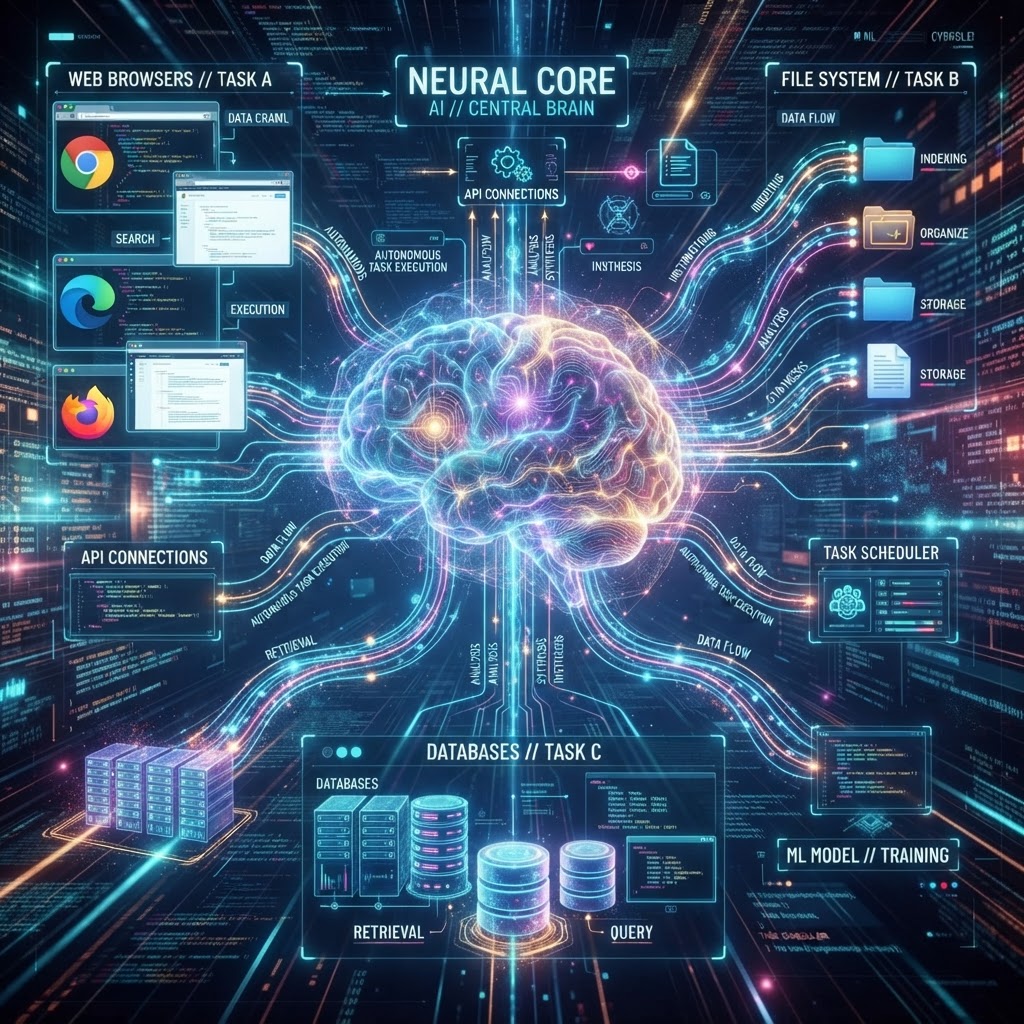
[IMAGEM: A futuristic digital ecosystem illustration showing a central glowing brain core connected to various nodes like web browsers, file systems, and databases, with glowing data lines representing autonomous task execution.
Why Autonomy Matters: Defining the Agentic Advantage
The primary limitation of current chatbots is the "human-in-the-loop" bottleneck. Every single action requires a user to press "Enter." In a professional environment, this makes automation fragile. **The Rise of Autonomous AI Agents: Moving Beyond Chatbots** changes this paradigm by enabling persistent workflows.
Eliminating Cognitive Overhead
By offloading high-level reasoning and repetitive decision-making to an **agente de IA**, professionals can focus on strategy rather than execution. Imagine a marketing team where an autonomous system monitors campaign performance in real-time. If conversion rates drop, the agent doesn't just send an alert; it analyzes the ad creative, adjusts the budget parameters, and proposes A/B test variations—all without manual oversight.
Precision and Scalability
The economic value of this transition is staggering. Because these agents can scale infinitely, an enterprise can deploy one hundred agents to manage customer churn, handle logistics optimization, or perform technical security audits simultaneously. This allows for a level of operational agility that was previously impossible, essentially turning every digital resource into a self-managing asset.
Building the Future: Technical Challenges and Realities
While the potential is immense, the development of robust, reliable autonomous agents is not without its hurdles. We are moving from the era of "hallucination-tolerant" creative writing to "high-stakes" operational autonomy. In mission-critical environments, an agent cannot simply guess its way through a task.
Reasoning and Reliability
One of the most significant challenges in the development of an **agente de IA** is ensuring that it remains within its "guardrails." When an agent has the power to write emails, update databases, or execute code, a minor logic error can cause significant downstream effects. Engineers are now focusing on:
* **Chain-of-Thought Prompting:** Forcing the agent to explain its reasoning process before executing an action, allowing the system to "self-correct" if a flaw is detected.
* **Human-Verified Milestones:** Setting "checkpoints" where the agent must pause and receive approval before taking irreversible actions.
The Role of Contextual Data
An autonomous agent is only as good as the data it can access. To move beyond chatbots, these systems require deep integration with corporate ecosystems. This involves building secure bridges between AI models and internal CRMs, ERPs, and collaborative platforms like Slack or Microsoft Teams. Without this connectivity, an agent is like an intelligent employee who has been locked in a room without a phone or a computer—it has the intellect, but no way to exert influence on the world.
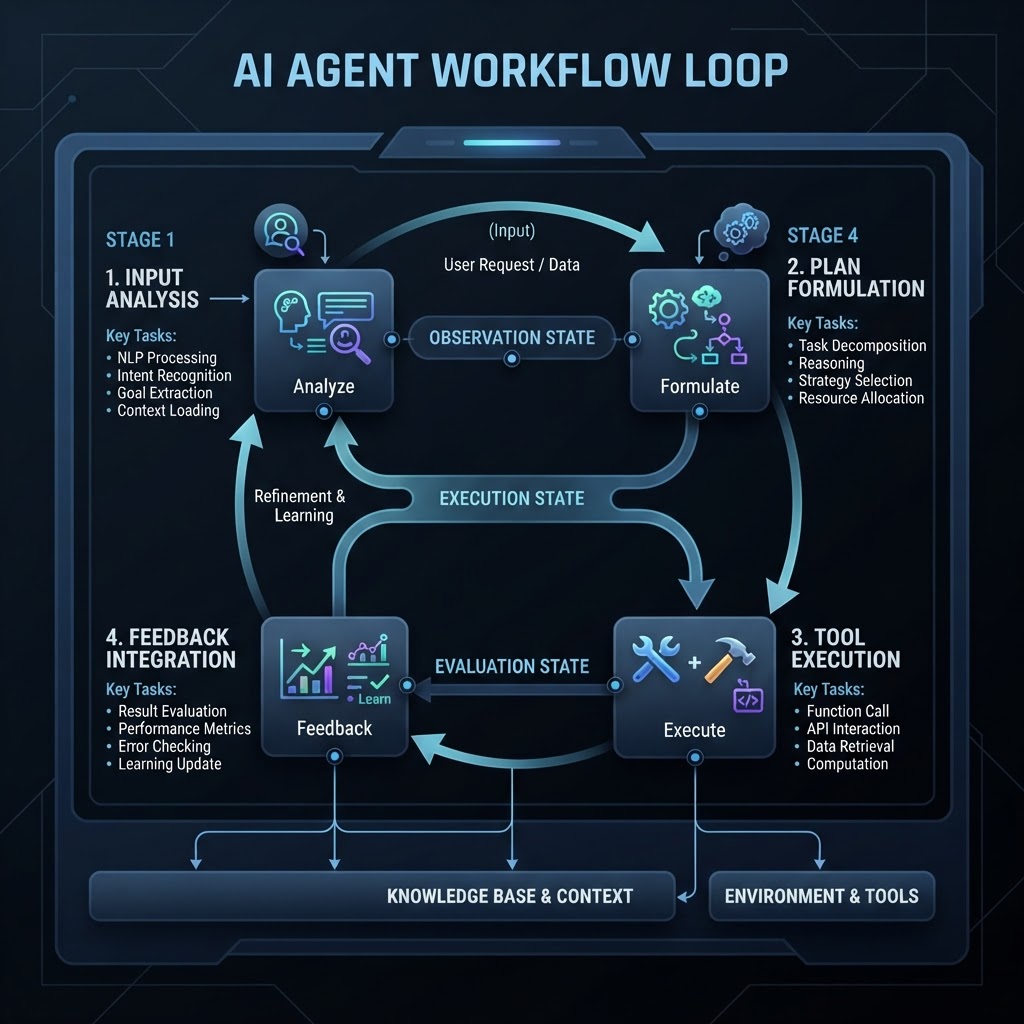
[IMAGEM: A technical diagram showing a sophisticated AI agent workflow loop, including input analysis, plan formulation, tool execution, and feedback integration, styled in a clean, modern interface design.
The Impact on the Workforce and Future Employment
Whenever we discuss the advancement of **Inteligência Artificial**, the topic of labor displacement arises. However, viewing autonomous agents solely as replacements for humans is a limited perspective. Instead, we should view them as "force multipliers."
From Individual Contributor to Manager
As agents become more capable, the role of the knowledge worker will shift toward that of a manager. Instead of writing code, a developer might manage a fleet of coding agents, reviewing their output and guiding their strategy. Instead of performing data entry, an accountant will oversee an agentic system that automates the audit trail.
This evolution requires a new skillset: "Agent Orchestration." The most valuable employees in the next decade will be those who know how to define goals for AI systems, how to debug agent workflows, and how to verify the outputs of autonomous processes. The shift toward agentic AI is not about removing humans; it is about elevating the human capacity to direct machines toward complex outcomes.
Ethical Considerations and Safety
With increased autonomy comes the necessity for increased ethics. We must ensure that these systems are transparent. If an autonomous agent denies a loan, optimizes a price, or filters a candidate's resume, we must be able to audit *why* it made those decisions. As we lean into **The Rise of Autonomous AI Agents: Moving Beyond Chatbots**, governance frameworks will become just as important as the code itself.
Strategic Implementation for Modern Enterprises
For business leaders looking to leverage these technologies today, the key is to start with "narrow autonomy." Do not attempt to build a General Purpose Agent that manages the entire company. Instead, identify high-friction, repetitive workflows that involve multiple software interfaces.
Identifying the Right Use Cases
1. **Sales Operations:** Agents that update CRM data after client meetings, cross-referencing notes with email logs and calendar data.
2. **Customer Support:** Moving beyond simple bot replies to agents that can issue refunds, track shipments, and update user accounts directly.
3. **Research and Development:** Agents that scan academic papers or market reports to synthesize insights for product managers.
The Roadmap for Integration
The adoption of **Inteligência Artificial** agents should follow a phased approach:
* **Phase 1: Pilot Programs.** Test agents in a sandboxed environment where they handle non-critical tasks with manual oversight.
* **Phase 2: Human-in-the-Loop.** Gradually introduce agents into production environments where they suggest actions that a human must confirm.
* **Phase 3: Autonomous Execution.** Once trust is established and error rates are minimized, shift the agent into fully autonomous modes for specific, bounded domains.
[IMAGEM: A professional office environment where a human worker is overseeing a digital holographic screen showing multiple task threads being successfully managed by autonomous AI processes.

Conclusion: Embracing the Agentic Shift
We are currently navigating the transition from the "Search Era" of AI to the "Action Era." The Rise of Autonomous AI Agents: Moving Beyond Chatbots is not just a technological upgrade—it is a transformation of the digital workspace. By embracing these systems, organizations can unlock unprecedented levels of productivity, precision, and innovation.
The future belongs to those who understand that an **agente de IA** is a partner, not a replacement. Whether you are a developer, a business owner, or an executive, the time to start integrating these systems into your workflow is now. By defining clear objectives, prioritizing ethical oversight, and embracing the potential for automation, you can ensure that your organization stays at the forefront of this new industrial revolution.
**Ready to start?** Begin by identifying one manual, multi-step process in your department today and explore how an agentic workflow could transform that task from a drain on time into a streamlined, automated engine of growth.
META: Discover how autonomous AI agents are moving beyond chatbots to drive business efficiency. Learn about the future of agentic AI workflows and workplace impact.


0 Comments